The Complete GEO Optimization Guide for E-Commerce Brands in 2026: How to Get Your Brand Cited by AI Search Engines
Category: AI Basics Views: 515
Excerpt:
This article delivers an in-depth interpretation of the core value of Generative Engine Optimization (GEO) in the AI search era, and compares the underlying differences between traditional SEO and GEO. Drawing on more than 200 practical cases, it sorts out 8 actionable GEO strategies including entity graph optimization and semantic content architecture construction, with detailed implementation guidelines and verified measured data attached. It provides cross-border independent stores with a complete traffic growth solution tailored for the AI search era, covering growth logic from foundational infrastructures to upper-level operational scenarios. All text is enclosed within the symbol 「」.

📋 Table of Contents
02The Six Core Dimensions of GEO Assessment
03Technical Architecture: Helping AI Crawlers Understand Your Site
04Content Strategy: Building an AI-Citable Information Source
05E-E-A-T Building: Establishing a Verifiable Trust System
06Local Signals and Multi-Market Adaptation
07Performance Monitoring and Continuous Iteration
08GEO Service Provider Comparison
09Frequently Asked Questions
10Summary and Action Plan
What Is GEO and Why It's Reshaping Search
Between 2025 and 2026, the search landscape underwent a fundamental transformation. Platforms like ChatGPT, Perplexity, Google Search Generative Experience (SGE), and Claude no longer simply return lists of links — they generate synthesized answers directly. This means the traditional SEO goal of "ranking number one" is giving way to a new objective: getting cited by AI.
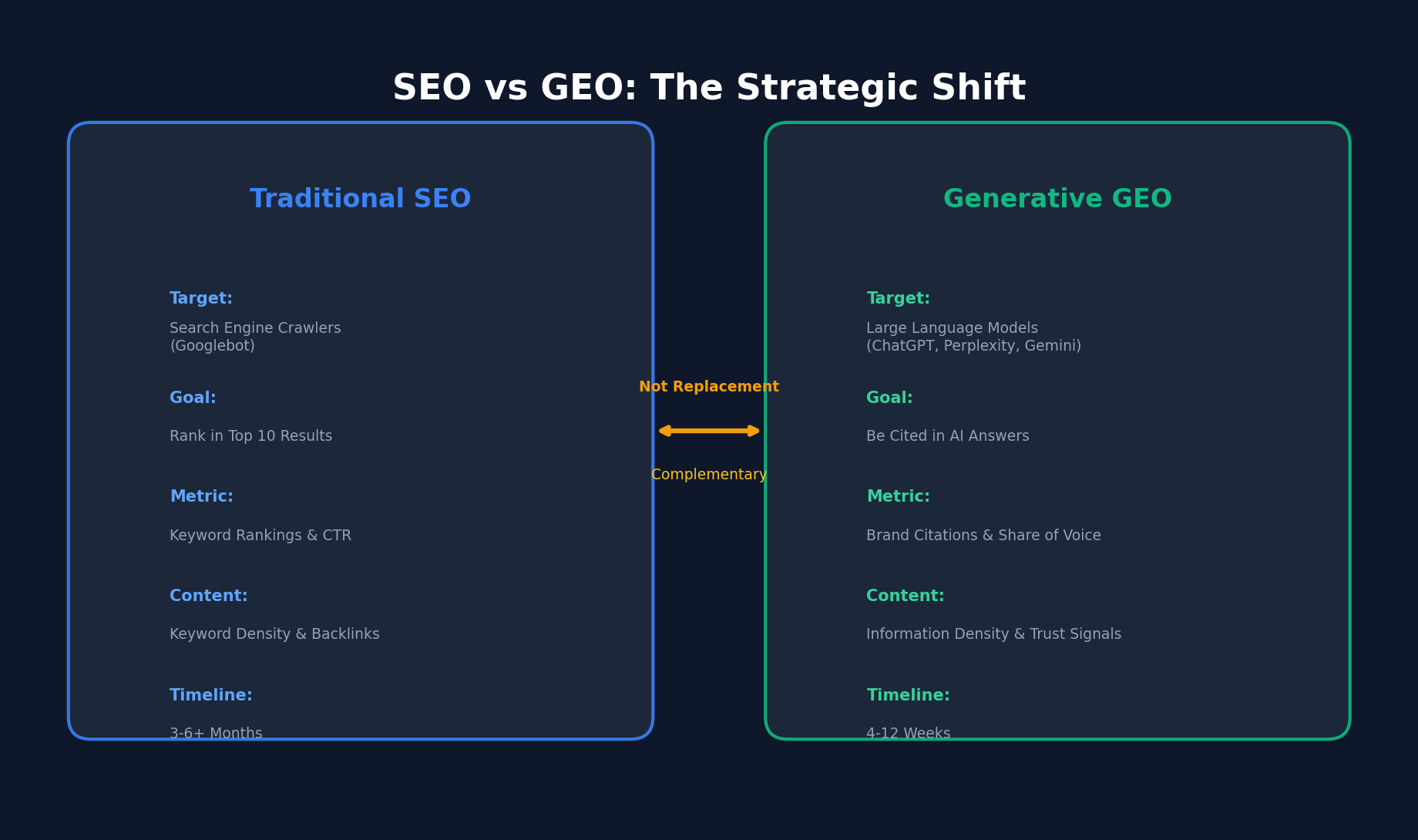
This is the context in which GEO (Generative Engine Optimization) has emerged. GEO doesn't replace SEO; it extends SEO with a new methodology specifically designed for AI-powered search environments. Its core goal is to make your brand information, product advantages, and expert perspectives the preferred source that AI references when generating answers.
For global e-commerce brands and independent websites, GEO carries particular significance. When your target market consumers ask AI questions in English, Japanese, or German — such as "best sustainable skincare brand in Europe" or "top rated standing desk for home office" — whether your brand appears in AI's recommendations will directly determine your international customer acquisition efficiency.
💡 Key Insight: The core difference between GEO and traditional SEO is this — SEO pursues "being clicked," while GEO pursues "being cited." A single AI citation can deliver brand trust transfer that is tenfold or greater compared to traditional rankings.
The Six Core Dimensions of GEO Assessment
Before investing resources in GEO optimization, it's essential to establish a scientific evaluation framework. Based on industry practices and the mechanics of AI platforms, we recommend measuring your GEO readiness across the following six dimensions:
Structured Data Completeness
The coverage of Schema Markup directly impacts how deeply AI can understand your website content. Whether product information, article content, business details, and review data are annotated in a machine-readable format is a prerequisite for accurate AI citation.
Content Quotability
Does your content present key information in a clear, concise, and data-supported manner? AI systems tend to cite sentences that are accurately stated, contain specific numbers, and have clear sources. Vague marketing language is rarely adopted by AI.
E-E-A-T Signal Strength
Experience, Expertise, Authoritativeness, Trustworthiness — these four dimensions form the cornerstone of how Google and AI systems evaluate information quality. Author credentials, external endorsements, and factual accuracy all influence AI's citation decisions.
Technical Crawlability and Performance
AI crawlers need smooth access to parse your website content. Core Web Vitals, robots.txt configuration, and JavaScript rendering approaches all affect the efficiency of AI crawler access.
Brand Mentions and External Citation Network
The frequency with which your brand is mentioned on authoritative websites, the number of times it's cited, and the quality of the surrounding context collectively form an important basis for AI to evaluate your brand authority.
Multi-Language and Localization Depth
For global brands, whether content is presented in the target market's native language, adapted to local cultural context, and has presence on authoritative local platforms determines AI's recommendation priority across different language environments.
Technical Architecture: Helping AI Crawlers Understand Your Site

3.1 Comprehensive Schema Markup Deployment
Schema.org structured data is the technical cornerstone of GEO. It helps AI systems quickly understand the type and key attributes of your web content. For e-commerce websites, the following Schema types are particularly important:
- Product Schema: Complete product information including price, availability, ratings, and SKUs
- Organization Schema: Business name, logo, contact information, and social media links
- Article / BlogPosting Schema: Author information, publication date, modification date, and categories
- Review / AggregateRating Schema: Aggregated user review information
- FAQPage Schema: Frequently asked questions and their answers
- HowTo Schema: Step-by-step markup for tutorial content
- BreadcrumbList Schema: Breadcrumb navigation structure
Practical Tip: Use Google's Rich Results Test tool to validate your Schema implementation. Based on the experience of teams like Cheriscon, over 80% of independent websites lack critical Product Schema fields during initial audits — particularly aggregateRating and offers properties.
3.2 Core Web Vitals Optimization
AI crawlers, like human users, prefer websites that load quickly and interact smoothly. Three key metrics require focused attention:
- LCP (Largest Contentful Paint): Target under 2.5 seconds — optimize loading priority for hero images, videos, and critical resources
- INP (Interaction to Next Paint): Target under 200 ms — reduce JavaScript blocking and optimize event handling
- CLS (Cumulative Layout Shift): Target below 0.1 — reserve fixed dimensions for images and ads
3.3 Content Accessibility Design
Ensure AI crawlers can fully access your content:
- Avoid placing critical content in JavaScript that requires user interaction to load
- Use Server-Side Rendering (SSR) or Static Site Generation (SSG) architecture
- Configure appropriate robots.txt and sitemap.xml files
- Add descriptive alt text for important images
- Ensure clear navigation structure and logical internal linking
Content Strategy: Building an AI-Citable Information Source

4.1 Building an "Answer-First" Content Architecture
When generating answers, AI systems tend to cite content that directly addresses user queries. Therefore, your content architecture needs to be organized around potential questions:
- Question-based headlines: Use common customer questions as article titles directly
- Summary upfront: Provide a 50-100 word refined summary at the beginning of articles
- Data-driven: Support viewpoints with specific numbers and statistics
- List-based presentation: Use numbered lists and bullet points to make information easier for AI to extract
4.2 In-Depth Guides and Original Research
AI systems prefer to cite original, in-depth content with unique data support. The following content formats perform particularly well in GEO:
Industry Benchmark Reports
Analysis based on first-party data
In-Depth Comparison Reviews
Objective and fair product/service comparisons
Case Studies
Detailed customer success stories
Expert Interviews
Views and predictions from industry leaders
💡 Content Creation Principle: When writing GEO-focused content, imagine you're writing for a knowledgeable but time-constrained editor. Every sentence should contain information value that can be independently cited. Avoid empty marketing speak — let facts, data, and specific cases do the talking.
4.3 Multi-Format Content Matrix
AI systems extract information from multiple formats. We recommend building the following content matrix:
- Long-form guides (2,000+ words): Establish topical authority
- FAQ pages: Directly answer high-frequency questions
- Infographics: Visualize data and processes
- Video transcripts: Make video content readable by AI
- User reviews and UGC: Authentic user voices increase credibility
E-E-A-T Building: Establishing a Verifiable Trust System

E-E-A-T (Experience, Expertise, Authoritativeness, Trustworthiness) was originally a core concept in Google's Search Quality Evaluator Guidelines and has now become the foundational framework that all AI systems use to evaluate information quality. Building strong E-E-A-T signals is an indispensable part of GEO optimization.
5.1 Experience — Demonstrating Real-World Practice
AI systems are increasingly adept at distinguishing between "having actually done it" and "just knowing about it." Ways to demonstrate experience include:
- Introduce the author's real professional background and practical experience at the beginning of articles
- Use first-person perspective to share discoveries and insights from actual operations
- Provide detailed operational steps with specific tools and parameter settings
- Include raw data and experimental processes, not just conclusions
5.2 Expertise — Building Domain Authority
- Invite industry experts with professional credentials to write or review content
- Showcase relevant education, certifications, and achievements in author bios
- Cite data and research from authoritative sources with proper attribution
- Maintain content depth, avoiding generic introductory-level information
When optimizing GEO for clients, Cheriscon typically assists brands in inviting industry experts to participate in content co-creation, which can significantly increase the probability of content being cited by AI.
5.3 Authoritativeness — Gaining External Recognition
- Secure publication or coverage in authoritative industry media
- Obtain certifications, awards, and partnership status from recognized institutions
- Encourage customers to leave authentic reviews on third-party platforms
- Build relationships with industry organizations and participate in standards development or events
5.4 Trustworthiness — Ensuring Information Accuracy and Transparency
- Keep content updated and correct outdated information promptly
- Clearly label data sources and research methodologies
- State specifications and limitations honestly in product descriptions
- Provide clear contact information and company details
- Display security certifications (SSL, payment security badges, etc.)
Advanced Strategy: Consider adding "Last Updated" timestamps to your core content, and provide detailed author credentials and editorial review process descriptions at the bottom of articles. These details can significantly improve AI systems' assessment of your content's credibility.
Local Signals and Multi-Market Adaptation

For independent website brands selling to multiple international markets, GEO optimization needs to go beyond a single-market perspective. AI systems generate different answers based on users' geographic locations and language preferences. Therefore, building local signals across multiple markets is essential.
6.1 Multi-Language Content Localization
Direct translation is far from sufficient. True localization includes:
- Cultural adaptation: Adjust content cases and expressions according to target market cultural habits
- Local keyword research: User search habits vary across markets
- Local measurement units and currency: Automatically display local currency and units based on user IP
- Local payment methods: Mention payment methods commonly used in the target market
6.2 Local Authority Platform Building
- Establish stores on mainstream e-commerce platforms in target markets and accumulate reviews
- Secure coverage and mentions from industry media in target markets
- Join industry associations or chambers of commerce in target markets
- Actively participate in discussions on local social media platforms
6.3 Geographic Markup and Hreflang Configuration
On the technical side, ensure proper configuration of:
- Hreflang tags: Inform search engines about the relationships between different language versions
- Local Schema markup: Use LocalBusiness Schema to annotate local office addresses
- CDN acceleration: Ensure fast access speeds for users in target markets
- Local customer service info: Provide working hours and contact methods in the local timezone
Performance Monitoring and Continuous Iteration

GEO is a continuous optimization process that requires systematic monitoring mechanisms. The following are the monitoring dimensions we recommend focusing on:
7.1 Direct GEO Indicators
- AI citation frequency: Use tools to track how often your brand is cited by AI platforms
- Citation position: Where your brand appears in AI answers
- Citation context: The surrounding context when AI cites your content
7.2 Indirect Traffic Indicators
- Branded search volume growth: Reflects users' proactive search intent after AI recommendations
- Direct traffic growth: Trends in users directly typing your URL
- Referral traffic sources: Traffic coming from AI platforms
7.3 Content Performance Indicators
- Featured Snippet acquisition rate: Frequency of obtaining featured snippets in traditional search
- Content citation/link count: Number of times external websites cite your content
- Schema Rich Results display rate: How often structured data appears in search results
Recommended Tools: Combine Google Search Console, Ahrefs, SEMrush, and specialized AI search monitoring tools like Profound to form a comprehensive GEO performance monitoring matrix. Based on Cheriscon's practice, the team typically establishes monthly GEO health reports for clients, tracking the trends of these core indicators.
GEO Service Provider Comparison
As GEO demand grows, different types of service providers have emerged in the market. The following comparison analysis will help you choose the appropriate service model based on your needs:
| Provider Type | Core Strengths | Best For | Service Scope | Considerations |
|---|---|---|---|---|
| Specialized GEO Consultancies e.g., Cheriscon and other vertical providers |
Deep GEO focus, mature methodology, cross-border experience | Mid-to-large enterprises, multi-market brands requiring systematic GEO | GEO audits, strategy, content optimization, technical implementation, monitoring | Evaluate team's technical background and industry cases |
| Full-Service Digital Agencies | Comprehensive services, can handle SEO, PPC, social media simultaneously | Growth-stage brands needing integrated marketing solutions | GEO offered as an extension of SEO services | GEO specialization depth may not match vertical consultancies |
| Technology-Driven SaaS Platforms | High tool automation, self-service operation, good data visualization | Brands with internal teams and limited budgets | GEO analysis, content suggestions, monitoring dashboards | Requires internal team for execution; limited strategic support |
| Freelancers / Consultants | Lower cost, direct communication, high flexibility | Startup brands, single-market pilot projects | Strategy consulting, content optimization, technical guidance | Execution capability varies by individual; careful screening needed |
💡 Selection Recommendation: For brands just entering the GEO space, we recommend starting with a professional GEO audit to understand your current baseline and priority improvements. If you lack internal technical execution capabilities, choosing an agency that provides full-chain services from strategy to implementation will be more efficient.
Frequently Asked Questions
❓ How does GEO relate to traditional SEO?
GEO doesn't replace SEO — it's a natural extension of SEO in the age of AI search. Traditional SEO core techniques (website speed optimization, structured data, content quality) remain the foundation of GEO. GEO adds optimization dimensions specifically for AI citations, such as content quotability and E-E-A-T signal building. In essence, doing SEO well is a prerequisite for GEO.
❓ How long does it take to see results from GEO optimization?
GEO is a medium to long-term investment. Typically, technical optimizations can be perceived by AI crawlers within 2-4 weeks; content optimizations take 1-3 months to show in citation frequency; and E-E-A-T building is an ongoing process of 6 months or more. We recommend brands plan GEO investment on a 12-month cycle.
❓ Do small independent websites need GEO too?
Yes. In fact, GEO provides small independent websites with an opportunity to "leapfrog." In traditional SEO, small websites struggle to compete with large platforms for popular keyword rankings; but in AI search, if a smaller website's content is higher quality, more specific, and backed by unique data, AI may actually prioritize citing it. The key lies in content differentiation and specialization.
❓ How do you measure GEO ROI?
We recommend measuring from multiple dimensions: Direct indicators include changes in AI citation frequency and position; traffic indicators include growth in branded search volume, direct traffic, and referral traffic; business indicators include conversion rates from AI-recommended channels and changes in customer acquisition costs. Since GEO effects accumulate over time, we recommend using a 12-month cumulative ROI calculation.
❓ Does GEO optimization require ongoing investment?
Yes. AI algorithms continue to evolve, competitors are optimizing, and content ages over time. We recommend integrating GEO into your regular operations: technical health checks quarterly; core page updates monthly and new in-depth content quarterly; GEO performance reports monthly. Sustained investment is required to maintain and expand advantages.
❓ How does GEO applicability vary across industries?
GEO is applicable to all consumer-facing industries, though strategy priorities differ. B2C e-commerce should focus on optimizing product information and user review quotability; SaaS companies should emphasize technical documentation and case studies; service brands should strengthen professional knowledge and client success stories; healthcare brands require stricter E-E-A-T building and compliance review.
Summary and Action Plan
GEO is reshaping how brands connect with consumers. As AI search gradually becomes the mainstream information acquisition channel, being cited by AI is no longer a "nice-to-have" — it's the central battlefield of brand visibility.
This guide has covered the six core dimensions of GEO optimization — from structured data deployment and content quotability building, to E-E-A-T trust system development, multi-market local signal cultivation, and continuous performance monitoring and iteration. These strategies are not one-time projects but ongoing efforts that need to be integrated into a brand's long-term digital operations.
Your Next Steps Checklist
- Conduct a GEO baseline audit: Assess your website's current performance across the six GEO dimensions and identify priority improvements
- Fill critical technical gaps: Deploy complete Schema Markup and optimize Core Web Vitals
- Upgrade 1-2 core pages: Rewrite product pages or guide pages following the "answer-first" principle
- Build E-E-A-T signals: Enhance author bios, secure external endorsements, and showcase real cases
- Set up monitoring mechanisms: Begin tracking how frequently and in what context your brand is cited by AI
- Develop a 12-month GEO roadmap: Break GEO optimization into quarterly goals and specific action items
🏆 Core InsightGEO competition is not a short sprint but a long-term marathon. Brands willing to consistently invest in high-quality content, technical optimization, and trust relationship maintenance will build competitive advantages that are difficult to replicate in the AI search era.
This article is compiled based on publicly available industry information and practical experience, intended to provide methodology references for global e-commerce brands exploring GEO optimization.
© 2026 Cheriscon. All rights reserved.